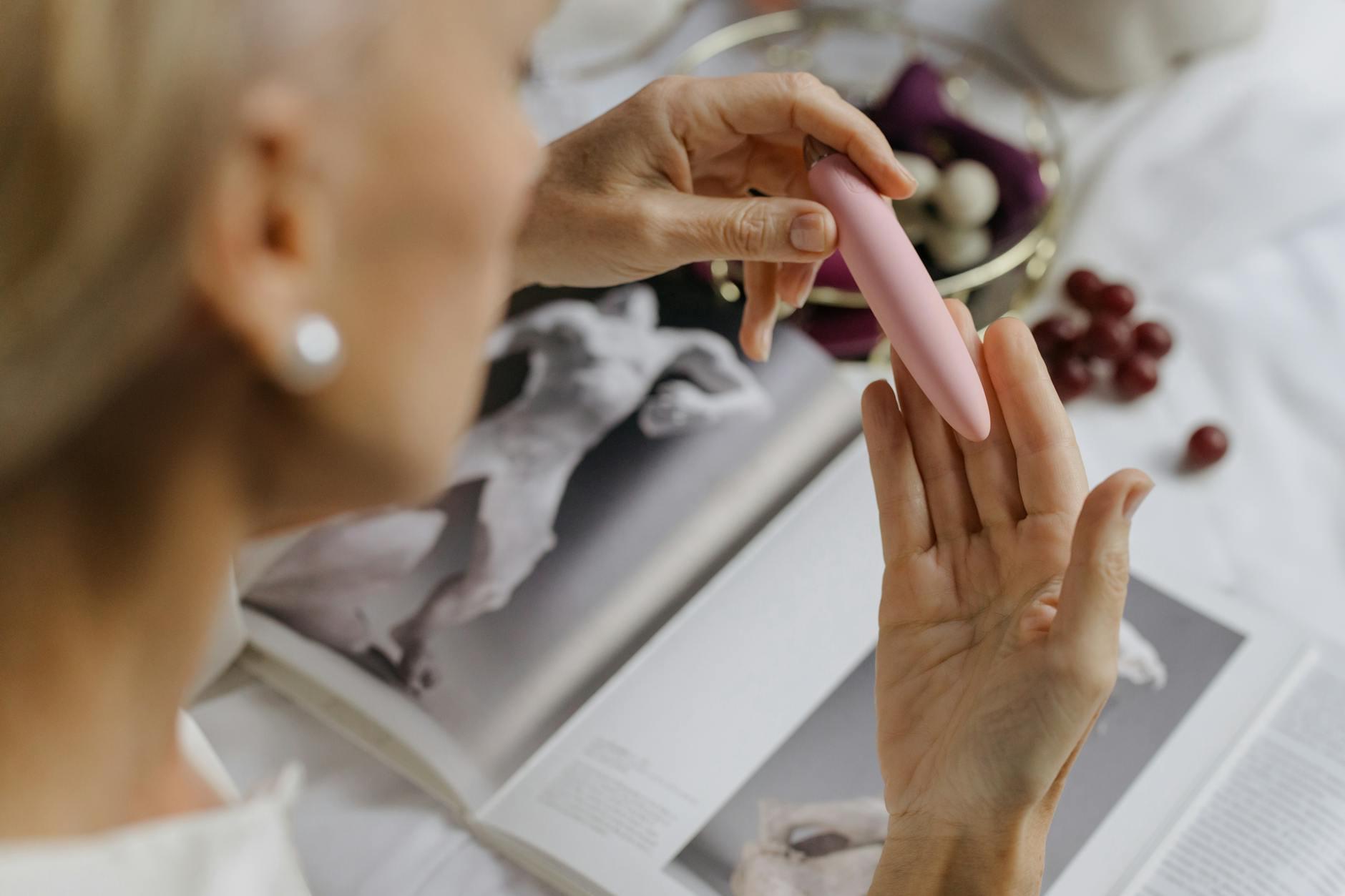
Let's start with what's actually happening
Perimenopause isn't menopause. It's the 5 to 10 years your body spends transitioning toward it, and honestly, it's way less talked about than it should be. Estrogen and progesterone don't drop like a cliff. They yo-yo. One week you're flooding, the next you're bone-dry. One day your skin is clear, the next you're breaking out. Same thing happens to arousal and sensation.
Your pleasure pathways haven't gone anywhere. But the speed bumps have moved.
How hormonal fluctuations rewire arousal
During your cycle (yes, you still have one in perimenopause, even if it's irregular), estrogen controls vaginal lubrication and how quickly blood flows to the clitoris. When estrogen is high, arousal builds faster and sensation feels sharper. When it crashes, everything moves slower and feels muted. Progesterone adds another layer. High progesterone can actually suppress desire and dull sensation.
Here's what matters: this isn't permanent within a cycle, and it's not a sign your pleasure is leaving for good. It's a shift in timing and intensity that you can work with instead of against.
Many people find that perimenopause actually clarifies things. When sensation varies week to week, you stop assuming you're broken and start paying attention to your actual body. That's useful information.
Why lemon vibrators feel different right now
A lemon clitoral vibrator like the Lem works through suction and pulsation, not friction. That matters in perimenopause because:
First, suction stimulates deeper nerve clusters without requiring the same skin-to-skin pressure that can feel raw or too intense when tissue is thinning. You get sensation without the mechanical irritation.
Second, the patterns on a lemon sexual toy give you control over intensity in a way that matches your week-to-week shifts. Some weeks you'll want pattern 1 or 2. Other weeks you might go higher. You're not locked into one intensity the way you might be with a partner's hand or mouth.
Third, the focused design of a clitoral vibrator means you're getting targeted stimulation exactly where you need it, without the whole-body arousal demand that used to work automatically but now takes longer to build.
The rhythm adjustment that changes everything
Perimenopause isn't the time to rush. Your nervous system needs more runway to shift into arousal. Budget 20 to 30 minutes instead of 10. This isn't because something's wrong. It's because your body is communicating a boundary, and honoring that boundary actually makes pleasure more reliable, not less.
When you show up with time, without pressure, arousal does build. It just takes the scenic route now. Some people find that slower ramp actually feels better. You're less likely to miss the subtler parts of sensation that faster arousal can skip over.
Start with the lower settings on a lem vibrator. Let your body acclimate. Many people in perimenopause find that patterns 2 through 4 hit differently than pattern 1, which can feel too sharp early in the process. Experiment. Your nerve sensitivity is still there. It's just asking for a slower introduction.
The lubrication conversation (without shame)
Some weeks in perimenopause, you'll be naturally lubricated. Other weeks, you won't be. That's not a failure. It's just variance.
Water-based lubricant is your friend now. Not because you're broken, but because external lubrication gives your body permission to focus on sensation instead of friction management. Your clitoris has thousands of nerve endings. They don't care whether wetness is self-generated or applied. They just want to feel good.
Use a lube that's glycerin-free if possible (especially if you have a history of yeast issues, which can spike during perimenopause due to hormonal shifts). Your Lem vibrator plays beautifully with any water-based option. A dime-sized amount is usually enough because suction-based lemon clitoral vibrators don't require the saturation that penetrative toys do.
The mental part (which often matters more)
Perimenopause arrives with a lot of other life events layered on top. Your kids might be launching. Work might be more demanding. Your relationship might feel different. Your body is definitely different. The temptation is to assume any change in pleasure is purely hormonal.
Sometimes it is. Sometimes it's also grief, distraction, or a need for deeper connection with yourself or a partner. Here's the thing. Those two conversations aren't the same. "My body is responding differently" is not the same as "I'm feeling disconnected." Treating them like they're one problem will solve neither.
If you're partnered, the most important thing you can do is separate the biology conversation from the intimacy conversation. Get clear on what's changing physically. Then, independently, ask whether the intimacy itself needs attention. Usually both need something, but they need different solutions.
When to use the Lem and when to skip it
If you're in the high-estrogen part of your perimenopause cycle, a lemon vibrator can feel amazing. Your tissues are fuller, sensation is sharper, arousal builds faster. Lower settings feel perfect.
If you're in the low-estrogen part, you might still want the Lem, but you might use it differently. You might warm up longer. You might start on pattern 2 instead of 1. You might use more lube. You might focus on pleasure that doesn't have an orgasm as the goal. Any of those adjustments is smart, not settling.
Some weeks you might not want external toys at all. You might want hands-only pleasure or partner touch or just rest. That's not a sign the Lem isn't working. It's a sign your body has different needs that week. Honor that. You're not obligated to want the same thing every week.
The pattern tracking hack
Keep a simple note on your phone. Track your cycle (even if it's wonky), and jot a one-word note about your sensation that week: "sharp," "muted," "slow," "intense." After 8 to 12 weeks, you'll see your own pattern. You'll know whether you tend to feel sharper mid-cycle or later. You'll know which patterns on your lemon sexual toy match each week best. You'll also know whether external factors (stress, sleep, connection with a partner) shift things more than hormones do.
That data is gold. It takes the guesswork out of "Is this perimenopause or is something else going on?" And it helps you plan intimacy around your actual body, not the body you think you should have.
What doesn't change (and this matters)
Your clitoris still has the same nerve density. Your brain's arousal pathways are intact. Your capacity for pleasure hasn't been revoked. The architecture of orgasm is still there. What's changed is the access route. The Lem is designed to work with that new route, not force the old one.
Many people report that their most satisfying orgasms come in perimenopause and after. This isn't optimism. It's clinical observation. When you're not running on hormonal autopilot, when you're actually attuned to your body's signals, when you have tools that work with those signals instead of against them, pleasure often deepens.
Perimenopause is not a deadline. It's information. Your job right now is to listen to that information and adjust your approach. The Lem does that work. A lemon clitoral vibrator gives you a tool that scales with your week. That's the whole point.
People also ask
Why does a lemon vibrator work better than a wand during perimenopause?
Wand vibrators deliver vibration across a larger surface area, which can feel too broad or too intense when tissue is thinning or sensation is muted. A lemon sucker like the Lem uses suction, which targets the deeper clitoral network without the same mechanical pressure. You get more precision and usually more sensation with less physical intensity. Plus, suction-based lemon sexual toys tend to feel less raw on delicate tissue. That said, some people love wands in perimenopause. It depends on your tissue sensitivity and what feels good that week.
Can perimenopause hormones actually block orgasm even if you're using the right toy?
Yes, temporarily. Progesterone, in particular, can suppress both desire and sensation. This can make orgasm harder to reach, even with a lemon vibrator that usually works great. It's not permanent. It's cyclical. If orgasm feels consistently blocked across multiple weeks, that's worth mentioning to a doctor. Thyroid issues, depression, sleep deprivation, and other factors can also muffle response. But within a normal perimenopause cycle, yes, some weeks are harder than others. That's expected.
How do I know if I need lubricant with a lemon clitoral vibrator during perimenopause?
Start dry and pay attention. If you're enjoying sensation and nothing feels uncomfortable, you probably don't need it. If there's any friction, rawness, or if sensation feels muted, add a small amount of water-based lube. Some weeks you'll need it, some you won't. The Lem is forgiving of both. Just make sure whatever lube you choose is water-based and compatible with silicone toys.
Is it normal for the same Lem settings to feel completely different week to week?
Completely normal. That's hormones. Pattern 3 might feel amazing one week and overwhelming the next. This isn't a sign the toy is broken or you're broken. It's a sign your nervous system is responding to changing hormone levels. Keep notes (seriously, the tracking hack is not overkill). After a few cycles, you'll start predicting which patterns will work best that week.
Should I use a lemon sexual toy less often during perimenopause?
No. There's no evidence that using the Lem more or less often changes how perimenopause progresses. Use it as much as it feels good. Some people find that regular pleasure actually helps regulate mood swings and sleep quality during perimenopause. Others find it's more useful in certain weeks. Both are fine. This is about what serves your body, not about following a rule.
What if lemon vibrators stop working for me during a particular phase of perimenopause?
They probably haven't stopped working. Your nervous system has just shifted into a different sensitivity mode that week. Try adjusting the pattern, adding lube, giving yourself more warm-up time, or focusing on sensation without the goal of orgasm. Sometimes what you actually need is a different kind of touch. Sometimes you need rest. Listen to that. The Lem will be there when your body is ready for it again.